

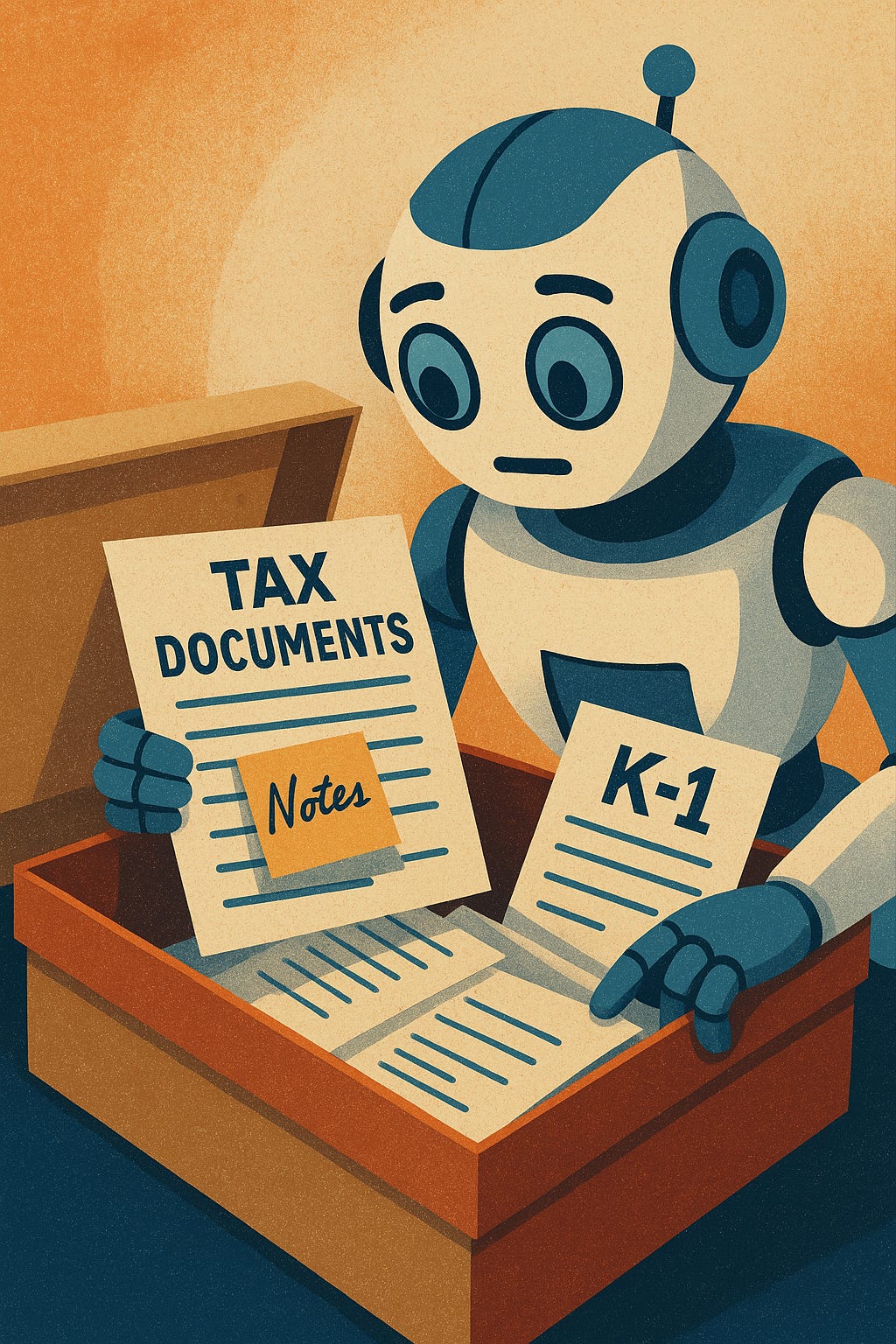
You feel it every April. The quiet dread. The shoebox of receipts. The half-remembered login to your tax software. The gnawing suspicion that you're missing something. And the cold, creeping question: Why is this still so hard? In a world where LLMs write poetry and cars drive themselves, why does tax season still feel like doing your own dental work?
The American tax system is not merely difficult—it's almost destined to be by its design. And not in the elegant, rules-based way that engineers or game designers might appreciate, but in a messy, sprawling, bureaucratically haunted way that reflects a century of accumulated political horse-trading. The harder you look at it, the clearer it becomes: we're not just dealing with forms and deductions—we're navigating a system shaped by decades of conflicting incentives, economic ideology, and quietly entrenched interests.
This piece is an attempt to unspool that knot a bit. We'll explore how we got such a Byzantine tax code in the first place. We'll look at the drift and divergence between income taxes, capital gains, and corporate taxes—each with their own political backstory. We'll follow the rise of tax software and e-filing, and why they didn't really fix the user experience. And finally, we'll land in the present: a moment when modern AI—specifically large language models and multimodal systems—are finally equipped to chew through the shoebox of tax documents and spit out something legible. Not just faster, but better.
Because in the end, filing taxes is mostly a data-entry problem. And if you've paid attention to what's happening in technology lately, you know that data entry is a problem we're suddenly very, very good at solving.
The Never-Ending Complexity of the Tax Code
Why is the U.S. tax code still so complex, despite constant calls to simplify it? The short answer: political incentives favor complexity. Every deduction or credit in the tax code has a constituency that benefits, and thus a defender. As one analyst put it, "Every deduction has a constituency and every loophole a defender."[1] Eliminating a tax break – even in the name of simplification – means taking away something that some group (often a well-organized, well-connected group) enjoys. Politicians, therefore, face strong pressure to preserve or add special provisions for favored causes, from mortgage interest to solar panels to craft beer. Over time, this leads to a "patchwork of exceptions and preferences designed more by lobbyists than by public servants."[2] The result is a tax code with little coherent philosophy – a jumble of incentives that reflects political bargaining rather than principle.
Paradoxically, politicians also gain points by advocating simplification. They hold up postcard-sized tax forms at rallies and decry the headache of IRS paperwork. But often this is simplification theater. A classic example came after the 2017 tax reform: the IRS unveiled a new Form 1040 the size of a postcard, as promised. However, to make that "postcard" work, taxpayers now had to attach six new supplementary schedules for all the details that didn't fit.[3] In practice the paperwork increased. The gimmick lasted only one chaotic filing season before the IRS scrapped it as unworkable.[4] The episode perfectly illustrates the dynamic: an appearance of simplification, but new rules and complexity lurking just beneath the surface.
Indeed, many so-called simplifications just shift complexity around. Lawmakers might raise the standard deduction (so fewer people itemize), but simultaneously introduce a complex new deduction for pass-through business income. Or they phase-out a tax benefit as income rises (to target it to a constituency), which creates intricate tax cliff effects. Politically, it's more palatable to add a new credit for a specific group than to broadly lower rates and eliminate all credits. Thus the code accretes layers: new rules, carve-outs, phase-outs, and exceptions, each satisfying some interest or policy goal, but cumulatively creating a system only a CPA (and masochistic tax software engineer) could love.
It's worth noting that Americans themselves are often complicit in this complexity. We collectively gripe about complicated taxes, yet we also cheer for tax breaks that benefit us personally. As political scientist Christopher Faricy observed, "The tax code is so complicated because it is filled with myriad deductions and exclusions that Americans can take for engaging in certain activities… rather than [the government] spending money directly… it places incentives in the tax code."[5] In other words, our tax code doubles as a stealth spending program: a way to reward behaviors (home ownership, retirement saving, etc.) via tax breaks instead of budget outlays. These indirect subsidies are politically popular – they often don't feel like government spending – and thus they persist. Most Americans like their own deductions (say, the mortgage interest or child tax credit) even if they dislike the overall complexity.[6] This preference for hidden incentives keeps the pressure on Congress not to truly streamline anything.
Over time, all these factors produce what we have today: a federal tax law running millions of words across statutes, regulations, and IRS guidance. By one count, as of 2015 the Internal Revenue Code itself was about 2.4 million words and the accompanying IRS regulations over 7.6 million words – more than 10 million words combined.[7] And it's not slowing down – since the 1950s, the tax law has grown steadily longer each year.[8] Unsurprisingly, Americans now spend around 6 to 7 billion hours annually on tax compliance tasks.[9] We have, in effect, created a vast, Rube Goldberg machine of a tax system that requires an entire cottage industry of software and professionals to navigate.
Perhaps the ultimate irony is that technology has advanced by leaps and bounds, but the system's complexity has outpaced it. As one report noted, "the amazing increases in technology since 1996 — including electronic filing — haven't been able to keep up with the increases in tax complications, making the process of filing a return even more difficult and time-consuming."[10] We'll see this more when we discuss TurboTax and e-filing: despite nearly all Americans now using computer software to prepare returns, the total time and hassle hasn't dropped accordingly. Complexity has a way of gobbling up efficiency gains. It's like a software codebase that gets more tangled as new features are bolted on; faster hardware only means the bloatware gets bigger.
In sum, tax complexity is a systemic outcome of how we do policy in the U.S. – a byproduct of democracy, lobbying, and citizens' own contradictory demands. Any genuine simplification would require removing popular goodies or fundamentally rethinking what we tax and why. That's a tough sell. As a result, every few years we get promises of a simpler tax code, and occasionally even some laudable reforms, but the complexity creeps back in through the side door. It's a thorny, perhaps unsolvable problem short of a radical overhaul. To appreciate how we got here, it helps to step back and look at the history of U.S. taxes – especially how different types of income ended up taxed so differently, which is itself a source of much complexity.
Divergent Paths: A Brief History of Income, Capital, and Corporate Taxes
The U.S. tax code wasn't always this byzantine. In the early 20th century, it was actually intended to be simple – at least for those few Americans who paid income tax at all. The first federal income tax under the 16th Amendment in 1913 was a scant 27 pages long and hit only high earners.[11] There was no concept of a separate "capital gains" rate or hundreds of special credits. But over the next century, the tax system underwent layer upon layer of change. Notably, three classes of taxes – individual income, capital gains, and corporate income – each evolved on their own trajectories, driven by different political and economic forces. By now, they have substantially diverged in treatment.
Class tax to mass tax
Before WWII, the income tax was largely a "class tax" on the wealthy. It was during WWII that it transformed into a "mass tax," as the government needed revenue and broadened the base dramatically (introducing wage withholding in 1943 to ensure everyone paid). The number of taxpayers exploded from a few million to over 40 million by 1945".[12] Tax rates also surged – the top marginal rate hit 94% on ultra-high incomes to finance the war.[13] This era cemented the income tax as the federal government's main revenue engine, but also set the stage for future complexity: once tens of millions were paying taxes, politicians quickly learned they could enact social and economic policies through the tax code. The post-WWII tax reforms in 1954 reorganized the tax statutes (creating the modern Internal Revenue Code of 1954) and maintained high rates, but also codified many exemptions and special treatments that had crept in. By the 1960s, features like the standard deduction, personal exemptions, and a panoply of deductions (medical, state/local taxes, etc.) were firmly in place – a broad tax base with many preferences.
Divergence of capital gains
A major split in tax treatment opened between wage income and capital gains (profits from selling investments). Initially, from 1913 up to 1921, capital gains were taxed at the same rates as ordinary income".[14] But Congress soon grew concerned that high taxes could discourage investment sales, so starting in the 1920s it introduced preferential treatment for capital gains. By 1942, long-term capital gains (assets held >6 months) enjoyed a 50% exclusion – meaning effectively half the gain was tax-free – or an alternative flat 25% tax option for those in very high brackets".[15] This set a long-lasting pattern: capital gains typically faced lower effective rates than labor income. The rationale was to incentivize investment, but it also created complexity (needing to define holding periods, special forms, etc.).
Over the decades, the capital gains rate seesawed with political tides. The Tax Reform Act of 1969 actually raised taxes on capital gains, amid concern that rich investors were paying too little. By the late 1970s, however, sentiment shifted again: inflation was pushing nominal gains into higher brackets, so in 1978 Congress slashed the top capital gains rate to 28% (down from ~35% prior).[16] President Reagan's 1981 tax cuts drove it even lower, to 20% – the lowest capital gains rate since the 1930s.[17] Thus by the mid-1980s, we had a huge gap: the top ordinary income tax rate was 50%, but capital gains maxed out at 20%. This gap invited a lot of tax arbitrage (people structuring income as capital gains).
Reform and regression
The 1986 Turning Point – In 1986, an unusual thing happened: Washington achieved a truly sweeping, bipartisan tax reform. The Tax Reform Act of 1986 broadened the tax base and lowered the top ordinary income rate to 28%, the lowest in modern history. In the process, it also eliminated the preferential rate for capital gains, taxing gains at the same 28% top rate.[18] For a brief moment, the divergence between how wages and investments were taxed practically disappeared. The idea was to simplify and remove incentives for tax sheltering (since previously people found creative ways to reclassify wages as capital gains).[19] And indeed, for a couple years tax complexity did drop – many shelters became unprofitable without the rate differential.[20]
That didn't last. Starting in the early 1990s, the divergence crept back in. Congress raised the top income tax rate in 1990 and again in 1993 (up to 39.6% for the highest earners), but kept capital gains capped at 28%.[21] Then in 1997, a bipartisan deal under President Clinton cut the capital gains rate further, to 20% again, while leaving ordinary rates high.[22] In the 2000s, President Bush reduced it to 15% (and also lowered taxes on dividends to 15%). So by the 2000s we once more had wages potentially taxed at ~35%+ vs. stock gains at 15%. This large gap spurred new tax-avoidance games (like private equity managers using "carried interest" to take compensation as capital gains, or complex derivatives to transform income into gains).[23][24] To this day, long-term capital gains enjoy a top federal rate of 20% (23.8% including the Medicare surtax) – significantly lower than the top 37% rate on ordinary income. Every attempt to equalize them runs into the age-old arguments about spurring investment and the specter of "double taxation" on corporate profits. Thus, the divergence remains, adding complexity through separate schedules, holding period rules, and the like.
Corporate taxes
Corporate income has its own saga. The U.S. has long had a separate corporate tax on profits, layered on top of the individual tax (when those profits are paid out as dividends or share sales). In the post-WWII period, corporate tax rates were extremely high – the rate was above 50% in the 1950s, peaking at 52.8% in 1968-69.[25] Corporations also faced an "excess profits tax" during the war years and a heavy load of regulations. Over time, concern about competitiveness and economic growth led to a gradual reduction. By the 1980s, the corporate rate was 46%. The Tax Reform Act of 1986, while raising some corporate taxes by closing loopholes, lowered the rate to 34% (later nudged to 35%). It stayed at ~35% for three decades, one of the highest in the OECD (leading to debates about U.S. companies shifting profits abroad). Finally in 2017, the Tax Cuts and Jobs Act slashed the federal corporate tax to 21%[26] – a historically low level.
What's interesting is that the three taxes – individual, capital gains, corporate – have diverged not just in rates, but in structure and timing. For instance, wage earners get taxed in real-time on each paycheck, whereas capital gains are only taxed on realization (when an asset is sold, which investors can choose if and when to do – leading to the "lock-in" effect). Corporate profits may face tax at the entity level and again at shareholder level (hence debates on "double taxation" and proposals for integration). Each realm has its own set of rules, deductions, and exceptions: e.g. depreciation schedules and foreign tax credits for companies, vs. charitable deductions and IRA exclusions for individuals. Over the 20th century, our tax system became a collection of subsystems, each tweaked in different directions by different reforms. This has added to complexity because many taxpayers interact with multiple parts – say, an entrepreneur pays corporate tax on her C-corp's profits, capital gains tax on selling some shares, and individual tax on her salary and dividends, plus payroll taxes for Social Security/Medicare. Navigating the interplay of all these is non-trivial, to put it mildly.
To summarize the historical trajectory: after WWII, the income tax became a mass phenomenon, and with it came widespread deductions and credits to satisfy various constituencies. In the Reagan era, there was a bold attempt to simplify and align different taxes (the 1986 act), but subsequent policy choices reintroduced disparities, notably making capital gains and corporate taxes much lower relative to individual taxes by the 2000s. Each round of reform had high-level goals (fairness, growth, simplicity), but often produced new complexity in implementation. This history explains why, for example, your taxes on $100k of income might vary wildly depending on whether it's salary, stock sale, or small-business profit – a complexity that is by design, shaped by a century of political compromise.
From Paper to Pixels: The Rise of E-Filing and TurboTax
Given this daunting tax code, it's no wonder that technology stepped in to ease the burden (or at least attempt to). The process of preparing and filing taxes has transformed since the 1980s: from pen-and-paper forms in the mail to seamless digital transmissions over the internet. But while the mechanics of filing became more convenient, the barriers to true simplification turned out not to be technological at all – they were political and economic. In fact, one of the little-discussed reasons tax filing in the U.S. remains cumbersome is that certain companies and interest groups prefer it that way.
Electronic tax filing (e-filing) began in a modest pilot program in 1986 – fittingly, around the same time the Tax Reform Act tried to simplify the code itself.[27] The IRS rolled out early e-file experiments in a few cities, requiring tax preparers to use dial-up modems to send returns. By 1990, e-file went nationwide and about 4.2 million returns were filed electronically that year.[28] It was an instant hit with the IRS and preparers: digital returns meant faster processing, fewer transcription errors, and quicker refunds. The IRS heavily promoted e-filing through the '90s. By 1998, around 20% of individual returns were e-filed. Then came the internet boom – companies like Intuit enabled people to file online from home. By 2007, about 57% of U.S. tax returns were e-filed, and that figure reached 89% by 2018.[29] Today, e-filing is the norm; for many younger taxpayers, the idea of mailing in a paper 1040 feels about as current as using a fax machine.
Alongside e-filing, tax preparation software emerged as a powerful force. Intuit's TurboTax is the flagship example. TurboTax began as a PC software package in the mid-1980s (first released by a company called Chipsoft, later acquired by Intuit in 1993). Its promise was to guide taxpayers through an interview, do the complicated math and forms in the background, and output a ready-to-file return. By simplifying the user experience, TurboTax and its competitors (like H&R Block's software) became extremely popular. TurboTax rode the wave of the PC revolution and later the internet: by the 2000s it dominated market share for DIY tax prep. Intuit cleverly marketed it as being "easy as 1-2-3" and guaranteed accuracy, which appealed to millions who were fed up with dense IRS instructions.
One might think that with 90+% of Americans using either software or paid professionals to handle their taxes,[30] the complexity problem would be largely solved – at least from the user's perspective. It's true that software has taken the edge off: for a straightforward wage earner, TurboTax can crunch numbers and auto-fill a lot of info (especially now with W-2s downloadable, etc.). But if you have a more involved situation – say a couple of K-1 partnership forms, some stock sales, maybe multiple state returns – you'll still spend long hours sifting through documents and answering software prompts. The overall time spent on tax prep hasn't dramatically plunged despite software; it's on the order of 6-8 billion hours a year.[31][32] Software helped, but has not been a panacea, mainly because the underlying rules are still mind-bogglingly complicated. As the Deseret News wryly observed in 2024, all our fancy software and e-filing haven't kept pace: technology gains were outmatched by "increases in tax complications".[33]
There is also a more cynical reason filing remains a chore: the tax prep industry has actively opposed measures that would simplify filing. Intuit (maker of TurboTax) and H&R Block have spent millions lobbying against proposals like "return-free filing" (where the IRS would send you a pre-filled return to just confirm and sign) or the IRS offering its own free online filing portal.[34][35] These companies have a vested interest in taxes not being too easy; after all, if doing your taxes took 5 minutes, you wouldn't need to buy TurboTax every year. For two decades, Intuit in particular has waged a quiet war to stop the government from making filing simpler. ProPublica's investigative series "The TurboTax Trap" documented how Intuit used lobbying, the revolving door, and even UX "dark patterns" to ensure taxpayers keep coming back to TurboTax.[36] For example, Intuit helped create the Free File Alliance, a public-private partnership where tax software companies offer free filing to lower-income taxpayers – on the condition that the IRS agreed not to develop its own free filing system.[37] This non-compete clause (in effect for years) kept the IRS from offering something like a government TurboTax. Even when the IRS launched "Free Fillable Forms," it was basically just digital blank forms, not an intuitive guided software, so it posed little threat to the industry.
The upshot is that, by design, filing taxes in the U.S. has remained a private-sector service rather than an automatic government service. In countries like Estonia or the U.K., many taxpayers simply get a pre-completed return from the government and click "OK." In the U.S., that approach has been stymied. Instead, we use commercial software that – while helpful – still requires the user to do a lot of work: gathering documents, answering a ton of questions, and sometimes paying upsells for advice. Intuit's success in lobbying to "fend off the government's attempts to make tax filing free and easy" built its multi-billion-dollar franchise.[38] Meanwhile, the IRS remained underfunded and cautious about stepping on industry toes, so it focused on improving back-end processing (like its efficient e-file systems) rather than front-end user experience.
It's a fascinating standoff: technologically, we could automate a great deal of tax prep for many people, but business interests and political narratives about the "role of government" have prevented that automation from being fully realized. Nevertheless, the trend is towards easier filing through tech. Each year more data flows automatically – your employer, bank, broker, healthcare marketplace, etc., all send both you and the IRS copies of your tax forms (W-2s, 1099s, 1095s). In theory, the IRS could assemble most of your return for you from this data. In practice, we rely on software as the middleman to gather and input it.
By now, nearly 94% of individual returns are prepared using software (either by taxpayers or by pros on their behalf) and 90% are filed electronically.[30:1] The paper-filing era is effectively over. The remaining friction is mostly the complex decision-making (figuring out which credits you qualify for, how to handle unusual situations) and data entry from forms the IRS doesn't have until you submit (like certain business schedules). This observation leads to an important insight: modern tax filing is largely a data-entry and data-transfer problem, married to a rules-engine problem. If your documents (income statements, etc.) could automatically populate your tax return correctly, and if the rules (tax law) could be applied consistently, the human effort would shrink dramatically.
It's precisely here that the current AI revolution is poised to have a big impact. AI in tax is not about robo-lawyers arguing in Tax Court; it's about automating the ingestion of various tax documents and intelligently preparing a return or giving guidance. Think of it as the ultimate extension of what TurboTax started – except now the machine can handle not just structured number-crunching, but also unstructured information and reasoning that previously needed a human.
Modern Tax Prep Is a Data-Entry Problem
At its core, filing taxes involves collecting data from a bunch of documents (W-2s, 1099s, K-1s, receipts, etc.) and plugging that data into the right spots on the right forms, according to a massive set of rules. That sounds like something a computer should do, not a human. Traditional software like TurboTax still largely relies on the human user to read off those documents and answer questions, because while numbers are easy ("Enter Box 1 of your W-2"), a lot of information is semi-structured or contextual (e.g. the line "other deductions" on a K-1 form comes with a footnote explanation that a human must interpret). But today's technology – especially large language models (LLMs) and advanced OCR (optical character recognition) – are superb at ingesting and interpreting documents. We now have the capability to feed a PDF of a tax form (or even a shoebox of receipts) into a chat dialogue and have it figure out what's what.
In other words, preparing a tax return is increasingly a document processing and classification task. It requires extracting structured data from forms, understanding sometimes ambiguous descriptions, applying tax law logic, and producing the result. Technology can already do many parts of this:
• OCR + Classification: Modern document systems can scan a pile of pages and identify what each page is (W-2 vs. 1099-B vs. K-1, etc.), then extract the key fields. Microsoft's Azure AI, for instance, has a prebuilt model that can pull data from common tax forms like W-2s and 1099s automatically[39], and several startups and tax tech companies have specialized models for more complex forms.
• Handling Unstructured Data (Notes and Footnotes): One of the hardest parts for traditional software is those free-form text areas – for example, the infamous "Statements" attached to Schedule K-1s. If you've ever invested in a partnership or S-corp, you know that along with the official K-1 form, they send pages of footnotes (sometimes called "white paper statements") explaining various allocations, deductions, and especially mysterious line items like "STMT" which refer to attached statements. These are essentially mini-narratives in tax-specific language. Tax pros often have to read them carefully to figure out, say, how much of the partnership income is qualified business income vs. a Section 1231 gain, etc. This is perfect fodder for LLMs: it's a chunk of text that needs to be understood in context and mapped to the tax return. Current solutions have begun tackling this. For example, SurePrep (a tax automation company) uses LLMs to "auto-suggest the appropriate destination for each line item" in a K-1 supplemental statement[40] – essentially interpreting the footnotes and deciding which tax form lines they affect. Another firm, K1x, built an AI-powered K-1 analyzer that extracts K-1 data in mere seconds per form, including all those footnote details, whereas a human might spend hours.[41] In sum, the system can read those comment sections and understand them enough to do the right thing in most cases, a task that was previously an annoying time sink for accountants.
• Tax Logic and Reasoning: Once the data is extracted, we still need to apply the tax rules – another thing that LLMs, especially the cutting edge ones, are surprisingly good at. In fact, when OpenAI unveiled GPT-4 in 2023, one of their demo examples was having it take a picture of a handwritten tax form and calculate the owed taxes, reasoning through the tax law. GPT-4 actually referenced IRS guidelines in its explanation. There are caveats: out-of-the-box LLMs aren't 100% reliable for compliance, and tax law is full of edge cases. However, with further improvements, the ability to run functions, and human validation, such systems can clearly serve as the brains of a tax prep system. A full-throttle version of this technology will be able to ask the client clarifying questions in plain language, cross-check inconsistencies, and even learn from prior year returns to maintain continuity (e.g., carryover losses, depreciation schedules, etc.).
In effect, LLM-powered software can act as tireless junior accountants, ingesting all your docs, doing the data entry, and preparing a draft return for a human to review. This isn't theoretical – it's being rolled out now in accounting firms. SurePrep's 1040 automation tools (used by many CPA firms) claim to cut preparation time by 30-40% by using AI to handle much of the grunt work.[42] Another startup, BlackLine, touts up to 90% time savings in some cases with their AI tax prep platform.[43] These tools combine OCR, machine learning models trained on tax documents, and even generative capablities for things like drafting client emails or summarizing tax law changes. The Big Four accounting firms are investing heavily as well – for instance, EY's Canvas and KPMG's Ignition have LLM components to analyze data and flag risks. The momentum is clear.
A concrete example to illustrate the difference: Imagine you receive a stack of 50 Schedule K-1s from various investments (not uncommon for, say, a high-net-worth individual or a family office). Traditionally, an accountant (or a team) might spend days opening each PDF, copying numbers into a spreadsheet or tax software, and carefully reading all the footnotes for special codes (is there UBTI? State-specific info? Foreign tax credits? etc.). It's tedious, manual, error-prone work – exactly the kind of thing that burns out junior staff.[44] Now imagine feeding all 50 PDFs to an LLM-powered system. The system auto-recognizes they're K-1s, parses each field, compiles a summary of all income, deductions, credits, etc., and even highlights any oddities (like "This K-1 reports $X of Section 179 deduction which may be limited" or "K-1 from partnership Y indicates foreign tax paid: consider Form 1116"). In minutes, it could produce a consolidated report of all 50 K-1s' data. A human CPA can then review that summary instead of slogging through each form. This is happening now with specialized tax software.[45] The time savings and reduction in mind-numbing work are enormous.
Crucially, these systems don't get tired or bored. It can scan a 300-page tax disclosure for some obscure detail without losing focus. It can recall the entire tax code (if properly fed or given retrieval tools) to ensure no deduction is missed. It can also learn firm-specific practices – for example, always classify a certain type of expense the same way the firm did last year (one company calls this the "Do It Like Last Year" feature).[46] This consistency reduces errors. In short, for the first time, we have technology that directly tackles complexity, rather than just making a user interface over it. LLM-powered systems can internalize the complexity so that the user experience becomes simpler – potentially far simpler than even TurboTax's interview. We're talking about, say, a digital tax assistant you could talk to: "Hey TaxAI, here are my documents (uploads them). Let me know if you need any other info." And it might come back with a few questions ("I see two different addresses on your documents; did you move states last year?") and then spit out: "All done, here's your draft return, you owe $5,200 because of X and Y." That scenario is not far-fetched at all with today's models and some workflow orchestration.
There are of course challenges and limits. Trust is a big one – taxpayers and tax pros need to trust the AI's output. Early forays (like some experiments asking GPT-4 tax questions) have shown LLMs can sometimes sound confident and plausible while being subtly wrong. No CPA wants to sign a return that an LLM-powered system prepared without thorough review. So likely we'll see human-computer collaboration: the system does the heavy lifting, the human does the high-level review and judgement calls. Another challenge is keeping a system updated with constantly changing tax laws (though honestly humans struggle with that too; an LLM can be retrained or updated more systematically). Data security is also paramount – these models dealing with sensitive financial info must be deployed carefully (likely on secure cloud instances or local servers, not just the public ChatGPT). But these are surmountable issues with proper engineering and regulation. In fact, 79% of surveyed accountants believe AI adoption will help attract and retain talent – probably because it takes away the drudgery, making the profession more appealing.[47]
We should highlight that these systems is not just about cutting labor – it can also enable new kinds of analysis. For example, once all your tax data is digitized and processed, an system could automatically scan for planning opportunities: "Hey, notice you had high capital gains this year – if you also donate appreciated stock instead of cash to your charity, you could save $X in taxes" – basically giving tailored advice that only the very wealthy typically get from expensive advisors. Democratizing that insight via technology is an exciting prospect. Another new capability is real-time or continuous tax monitoring. Instead of a once-a-year scramble, your tax software could be monitoring your finances year-round and warn you: "if you sell that stock now, it'll bump you into a higher bracket, perhaps wait until January." This blurs the line between tax prep and financial planning – an area ripe for new services.
Conclusion: Embrace an AI-Powered Future or Getting Squeezed
What does this all mean for the industry and taxpayers going forward? In a nutshell: those who leverage AI in tax will win on efficiency and value, and those who don't will find themselves increasingly squeezed. This applies especially to tax professionals and accounting firms. We're at a point similar to when bookkeeping moved from ledgers to Excel – a major leap in productivity is available, and early adopters gain a competitive edge.
Accounting firms that embrace AI tools are already seeing dramatic efficiency gains. We cited an example of a firm cutting prep time by 40% on individual returns by using AI automation[40:1]. Firms using AI also report saving significant hours per employee per month on routine tasks[47:1]. That directly boosts their bottom line (more work done with fewer staff hours) and frees up time to offer new, higher-margin services. For instance, if AI handles the grunt work of tax prep, a firm can redirect its human experts to advisory projects – like tax planning, strategic consulting, or resolving complex tax controversies – which clients are willing to pay more for. In essence, AI can elevate the role of the accountant from form-filler to strategic advisor. This is the "new service line" opportunity: services like real-time tax strategy, multi-year planning simulations, or even integrating tax advice with business analytics – things that were too time-consuming to scale before, but now can be offered because the compliance workload is lightened.
On the other side, consider a mid-sized accounting firm that sticks to the old ways – manually entering data, printing PDFs, doing everything with lots of human hours. At first, they may think it's fine: their clients are used to white-glove service. But over a few years, two things will happen. First, simple returns at the "bottom" will be scooped up by software. If an AI-driven app (perhaps an Intuit product or an IRS tool in the future) can handle an average person's taxes cheaply and accurately, many individuals and small businesses might opt for that rather than pay a professional a hefty fee. We already saw this with TurboTax, but AI will make the threshold of "too complex for software" much higher. So the low end of the market gets eaten by automation. Second, for more complex clients at the "top" end, those clients will gravitate to firms that provide the most value – which increasingly will be firms armed with AI offering faster turnaround, deeper insights, and maybe lower fees. A big firm that invested in AI might undercut mid-sized competitors because their cost per return is lower. Or they might simply wow the clients with more sophisticated advice (since they had time to analyze the data more). Either way, the traditional firm finds itself pinched: losing small clients to DIY solutions, and losing big clients to more advanced competitors.
There's data to back this up: a recent survey found 56% of accounting professionals believe the value of a firm drops if it doesn't use AI[48]. In other words, not adopting AI is seen as a risk to the firm's viability. And indeed, firms leveraging AI are perceived as "more efficient, competitive, and better positioned for long-term growth"[49]. This reflects a growing consensus that AI in accounting isn't a flashy gadget – it's becoming standard practice, much like using computers or the internet. Those who fear it or delay adoption may find themselves akin to a paper-based firm in an increasingly digital world.
From the taxpayer's perspective, an AI-infused tax ecosystem could be a blessing. Imagine taxes becoming a background task – you assemble your docs (or they flow in automatically), an AI prepares everything accurately, and you or your accountant just review the highlights. Less stress, fewer hours wasted hunched over forms in April. It could also mean fewer errors and notices; AI can cross-verify data against IRS records, reducing mismatches. And with accountants freed up to advise rather than input data, you might actually get proactive tips that save you money or align your finances better with your goals.
Of course, the ultimate simplification would be to genuinely simplify the tax code itself – remove 90% of the weird carve-outs and just have straightforward low rates. That would reduce the need for both human and AI assistance. But given the political realities we discussed, it seems highly unlikely. In the absence of that, technology is the pragmatic path to making the experience of taxes easier even if the law stays complex. It's telling that even the IRS is now piloting an LLM-powered chatbot to help answer taxpayer questions, and exploring direct e-file portals after decades of relying on private software. The winds are shifting toward leveraging tech for public good.
In a lightly philosophical sense, one might say we're coming full circle. We started with the idea that the tax code is complex because it's doing many things – not just raising revenue, but incentivizing and engineering societal outcomes. In a democracy, that's unlikely to change; we will always have a complex collective conversation encoded in our tax laws. What can change is how we interface with that complexity. Perhaps the true simplification will happen at the user interface layer, where advanced AI agents mediate between us and the arcane code, making it feel simple even if under the hood it isn't. In a way, it's like the evolution of computing: early computers were programmed with intricate machine code (complex), then we built compilers and operating systems so that users could click icons and not worry about the binary guts. AI could serve as the "operating system" for the tax code – letting us accomplish our task (compute and pay the correct tax) without having to manually process every line of the Internal Revenue Code.
The takeaway for professionals is clear: embrace these AI tools to elevate your practice. The firms that do are already seeing benefits and will pull ahead. Those that cling to purely manual methods may survive for a while (some clients will always want a human touch), but over time they'll feel the squeeze of rising costs and competitive pressure. Just as web software became indispensable in tax prep over the last 30 years, AI-powered software will become indispensable in the next few. It won't replace tax professionals; it will empower those who adapt, and possibly replace those who refuse to.
To conclude, the story of U.S. taxation has always been one of complex systems and clever workarounds – from the loopholes of yesteryear to the software of today. We're now entering the next chapter, where AI becomes the ultimate workaround to complexity: not by eliminating it (that battle is fought in Congress), but by abstracting it away for the user. It's an exciting development. It means that, perhaps for the first time in decades, we can envision a tax-filing experience that is almost effortless for the average person, even if the tax code behind the scenes remains as intricate as ever. The institutions – whether the IRS or private firms – that harness this potential will lead the way to a more efficient, user-friendly tax system. And maybe, just maybe, by taking the drudgery out of tax compliance, we can refocus the public discourse on the substance of tax policy itself (the fairness, the incentives, the economic impact) rather than annual rituals of forms and frustration. In the end, simplification may arrive not through law, but through code – the software kind, that is, backed by AI.
References
Reason Magazine. (2025). "These Reforms Would Simplify Our Messy Tax Code and Level the Playing Field" ↩︎
Business Insider. (2019). "The Republican Tax Reform Postcard is Dead" ↩︎
Ibid. ↩︎
Ibid. ↩︎
Maxwell Institute. (2025). "Faricy Explains Popularity of U.S.'s Complex Tax Code in Fortune" ↩︎
Ibid. ↩︎
Tax Foundation. (2025). "Federal Tax Laws and Regulations Are Now Over 10 Million Words Long" ↩︎
Ibid. ↩︎
Deseret News. (2024). "Income Taxes Are Too Complex" ↩︎
Ibid. ↩︎
Ibid. ↩︎
Intuit. (2025). "Brief History of Income Taxes in the U.S." ↩︎
Ibid. ↩︎
Wikipedia. (2025). "History of Taxation in the United States" ↩︎
Ibid. ↩︎
Tax Policy Center. (2025). "How Might Taxation of Capital Gains Be Improved?" ↩︎
Ibid. ↩︎
Ibid. ↩︎
Wikipedia. (2025). "History of Taxation in the United States," supra note 14. ↩︎
Ibid. ↩︎
Tax Policy Center. (2025). "How Might Taxation of Capital Gains Be Improved?," supra note 22. ↩︎
Ibid. ↩︎
Wikipedia. (2025). "History of Taxation in the United States," supra note 14. ↩︎
Ibid. ↩︎
Intuit. (2025). "Brief History of Income Taxes in the U.S.," supra note 12. ↩︎
IRS. (2024). "E-file Fact Sheet" ↩︎
Wikipedia. (2025). "IRS E-file" ↩︎
Tax Foundation. (2025). "Federal Tax Laws and Regulations Are Now Over 10 Million Words Long," supra note 7. ↩︎ ↩︎
Deseret News. (2024). "Income Taxes Are Too Complex," supra note 9. ↩︎
National Taxpayers Union Foundation. (2024). "65 Billion Hours, $260 Billion: What Tax Complexity Costs for Americans" ↩︎
(https://www.deseret.com/opinion/2024/08/13/income-taxes-are-too-complex/#:~:text=According to the Tax Foundation%2C,consuming) ↩︎
ProPublica. (2024). "Inside TurboTax's 20-Year Fight to Stop Americans from Filing Their Taxes for Free" ↩︎
ProPublica. (2024). "How TurboTax Just Tricked You into Paying to File Your Taxes" ↩︎
ProPublica. (2024). "Inside TurboTax's 20-Year Fight to Stop Americans from Filing Their Taxes for Free" ↩︎
Ibid. ↩︎
(https://www.propublica.org/article/inside-turbotax-20-year-fight-to-stop-americans-from-filing-their-taxes-for-free#:~:text=Inside TurboTax%'s 20,Filing Their Taxes for Free) ↩︎
Klippa. (2024). "Mistral OCR for Document Processing: The Good, The Bad, The Reality" ↩︎
SurePrep. (2024). "Turn AI Into Your Virtual Tax Preparer" ↩︎ ↩︎
K1x. (2024). "Can ChatGPT and AI Automate Analysis of K-1s?" ↩︎
SurePrep. (2024). "Turn AI Into Your Virtual Tax Preparer," supra note 42. ↩︎
BlackLine. (2024). "AI Tax Prep Platform" ↩︎
K1x. (2024). "Can ChatGPT and AI Automate Analysis of K-1s?," supra note 43. ↩︎
Ibid. ↩︎
SurePrep. (2024). "Turn AI Into Your Virtual Tax Preparer," supra note 42. ↩︎
Karbon. (2025). "State of AI in Accounting 2025 Report Reveals Competitive Advantage for Firms Embracing AI" ↩︎ ↩︎
Karbon. (2025). "The Future of Accounting: AI Adoption Survey Results" ↩︎
Karbon. (2025). "State of AI in Accounting 2025 Report" ↩︎